
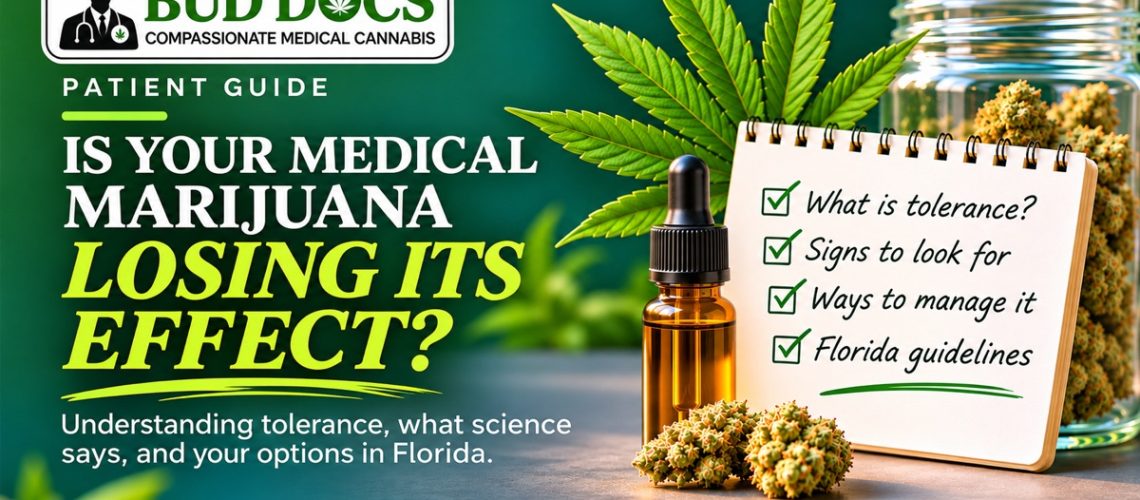
Patient Guide · Updated November 2026
Why your medicine can feel weaker over time, what the research says, and what Florida patients can do about it with their doctor.
If your usual dose has stopped doing what it did a few months ago, you are not imagining it, and you are not doing anything wrong. Regular use of THC changes how the brain responds to it. That change is called tolerance, and it is one of the most common questions patients bring to their medical marijuana appointments.
This guide explains what tolerance is, what the research shows, and which options Florida patients have. It also lays out Florida’s current dosing and supply limits, because they shape what is possible when your dose needs to change.
Phase 1
What tolerance is and why it happens
Tolerance means the same amount of a substance produces a smaller effect than it used to. It happens with many medicines. With THC, the main driver is the CB1 receptor, the part of your cells that THC attaches to in the brain.
The brain turns the volume down
When THC keeps activating CB1 receptors, the brain adapts by making fewer of them available. Researchers at Yale scanned the brains of 11 men with heavy cannabis use and found about 15% lower CB1 receptor availability than in healthy controls (D’Souza et al., 2016). An earlier imaging study found roughly 20% lower availability in daily smokers, concentrated in the cortex (Hirvonen et al., 2012).
The change is reversible
In the Yale study, the difference from controls was no longer statistically significant after 2 days of monitored abstinence, and there was no significant difference after 28 days. The earlier study reported that receptor levels returned to normal after about 4 weeks of monitored abstinence. Receptor recovery can start within days, though the Yale authors note that the increase over time was only a trend within their small group.
Real patients see it too
A 2025 study in Frontiers in Pharmacology looked at 16,395 medical cannabis patients who logged their first ten sessions in an app (42,005 sessions in total). Symptom relief fell by an average of 0.5% with each additional session. If that pattern held in a straight line, relief would be about 5% lower after ten sessions and 10% lower after twenty. The effect was stronger in people who described themselves as experienced users.
The same study found that higher THC and higher doses gave more relief, and also more side effects. Side effects became less common as sessions went on, so tolerance changed both sides of the trade. Patients raised their dose by only about 0.6% per session, which was not enough to make up for the loss.
The brain imaging studies were small and followed adult men with heavy, near-daily use. The app study covered only the first ten logged sessions and relied on patients’ own reports. Your experience may differ, and scientists are still learning how fast tolerance builds and clears for people using cannabis for a medical condition.
Phase 2
Is it tolerance, or something else?
Several signs often show up together when tolerance is building. Bring any of them to your doctor:
- You need a larger amount to get the same relief.
- The relief wears off sooner than it used to.
- You find yourself using more often through the day to stay comfortable.
- A product you liked for months seems to have stopped working.
A new product batch, a different way of taking it, a change in when you eat or take other medicines, or a change in your condition can all make your medicine feel different. Write down what changed so your doctor can sort out what is going on.
Phase 3
Options to discuss with your doctor
These are the approaches most often discussed in the research and in clinical practice. Your certifying physician decides what fits your condition, so use this as a list of questions for your next visit.
Keep a simple log
The app study worked because patients recorded the product, the dose, and how they felt each time. You can do the same in a notes app or on paper.
- Product name, form, and THC and CBD amounts from the label
- How much you took and the time
- Your symptom level before and after, on a scale of 0 to 10
- Any side effects
Review your dose and timing
Published dosing frameworks for medical cannabis generally start low and raise the dose gradually. The app study shows the trade: more THC and more volume help symptoms, but they also bring more side effects, and a larger dose can speed up tolerance for some people. Ask your doctor whether a lower dose, a different schedule, or a different THC and CBD balance makes sense for you.
Do not raise your dose on your own. In Florida, daily dose limits apply by product type (see Phase 4).
Rotate products or delivery methods
The authors of the 2025 study suggest that switching product types and cannabinoid profiles may help limit tolerance, and they note that patients in their data rarely changed THC levels. Florida dispensaries carry several forms, including smokable flower, vaporized products, edibles, oral capsules and tinctures, sublingual tinctures, suppositories and topicals. Each form has its own daily dose limit under state rules.
Dispensary staff can show you products with a different THC to CBD balance. Compare current Florida dispensary deals at buddeals.net.
Ask whether a tolerance break is right for you
A tolerance break means pausing THC for a set time so receptors can recover. The imaging studies suggest recovery can begin within about 2 days and continue over about 4 weeks. Withdrawal symptoms are expected to peak around day 2 of a break, and in the Yale study they tracked with how many receptors were available at that point. A break may also bring back the symptoms you are treating. That is why a break should be planned with your physician.
If you do pause, the Yale authors point out that patients who stop cannabinoid medicines for more than a few weeks may need their dose adjusted when they restart. The same dose can feel stronger after a break, so plan around driving, work, and other safety needs.
Use your renewal visit
Florida law requires your qualified physician to evaluate you at least once every 30 weeks before issuing a new certification. 30 weeks is 210 days, which is why patients hear “about every 7 months.” Your state ID card is renewed separately every 12 months. A bill in the 2026 legislative session would have lengthened the physician evaluation to every 52 weeks, but it died in committee on March 13, 2026, so the 30-week rule still stands.
Come to each renewal with your log. If a higher amount is medically appropriate, your physician can ask the Department of Health for an exception (see below).
Phase 4
Florida dosing and supply limits
Florida limits how much a qualified patient can obtain, and the limits count your purchases over rolling periods. Rule 64-4.224 of the Florida Administrative Code, which took effect on August 24, 2026, set these limits as permanent rules. They replaced earlier emergency rules, and the numbers below match the emergency rule 64ER22-8 that applied before.
| Form | Daily THC limit | 70-day THC limit |
|---|---|---|
| Edibles | 60 mg | 4,200 mg |
| Inhalation (vaporized) | 350 mg | 24,500 mg |
| Oral capsules or tinctures | 200 mg | 14,000 mg |
| Sublingual tinctures | 190 mg | 13,300 mg |
| Suppositories | 195 mg | 13,650 mg |
| Topicals | 150 mg | 10,500 mg |
Each 70-day limit equals the daily limit multiplied by 70. All forms other than smoking together cannot exceed 24,500 mg of THC per 70 days, so the six limits cannot be added together.
Smokable flower
Up to 2.5 ounces per rolling 35-day period, with a daily limit of 2.025 grams. You may possess up to 4 ounces of smokable marijuana at one time.
Physician certifications
A physician cannot certify more than three 70-day supplies, or six 35-day supplies of smokable marijuana, without requesting an exception.
A qualified physician can ask the Department of Health for an exception to the daily dose limit, the 35-day smoking supply limit, or the 4-ounce possession limit. The department must approve or deny a completed request within 14 calendar days. Approval is not automatic, and you should not buy above the standard limits until the exception shows in the registry. A possession exception is only approved together with an exception to the 35-day smoking limit.
Your remaining amount depends on your physician’s orders and your purchase history. The Office of Medical Marijuana Use (OMMU) publishes a guide to the Amount Available Calculation page in the Medical Marijuana Use Registry. For the latest rules, visit knowthefactsmmj.com.
Phase 5
A sensible path from here
- This weekStart your log. Record the product, dose, timing, and how you feel before and after.
- Before your next visitWrite down your questions: dose, THC and CBD balance, delivery method, and whether a break fits your situation.
- At your appointmentShare your log. Ask your physician whether to change your plan and whether an exception request is appropriate.
- After any changeKeep logging for a few weeks so you and your doctor can see what worked.
- At each 30-week renewalReview how your plan is holding up and adjust again if needed.
You keep needing more to feel normal, your symptoms return when you cut back, you find it hard to reduce use, or you feel unsafe driving or working. These are good reasons to ask for a review, and BudDocs can help you find the right support.
Sources
- D’Souza DC, Cortes-Briones JA, Ranganathan M, et al. Rapid changes in cannabinoid 1 receptor availability in cannabis-dependent male subjects after abstinence from cannabis. Biol Psychiatry Cogn Neurosci Neuroimaging. 2016;1(1):60-67. pmc.ncbi.nlm.nih.gov/articles/PMC4742341
- Hirvonen J, Goodwin RS, Li CT, et al. Reversible and regionally selective downregulation of brain cannabinoid CB1 receptors in chronic daily cannabis smokers. Mol Psychiatry. 2012;17:642-649. nature.com/articles/mp201182
- Stith SS, Li X, Brockelman F, Keeling K, Hall B, Vigil JM. Cannabis tolerance reduces symptom relief. Front Pharmacol. 2025;16:1496232. doi.org/10.3389/fphar.2025.1496232
- Florida Administrative Code Rule 64-4.224, Dosing and Supply Limits for Medical Marijuana (effective 8/24/2026). flrules.org
- Florida Administrative Code Rule 64ER22-8 (emergency rule, replaced). law.cornell.edu
- Florida Statutes s. 381.986, Medical use of marijuana; Florida Senate, CS/SB 1032 (2026), bill history. flsenate.gov/Session/Bill/2026/1032
- Florida Boards of Medicine and Osteopathic Medicine, Physician Certification Pattern Review, 2026 Annual Report. flboardofmedicine.gov
- Florida Department of Health, Office of Medical Marijuana Use. knowthefactsmmj.com
Talk with BudDocs
Our physician-led team in Lake Mary can review your plan, answer questions about tolerance, and help you with your next renewal.
- Address
- 917 Rinehart Rd, Suite 2061, Lake Mary, FL 32746
- Phone
- 1-800-652-0592
- [email protected]
- Booking
- buddocs.org/booking
Don’t Hate, Medicate™
This guide is for education and is not medical advice. Do not change your dose, stop a medicine, or start a tolerance break without talking to your certifying physician. Florida rules can change, so confirm current limits with the Office of Medical Marijuana Use.